

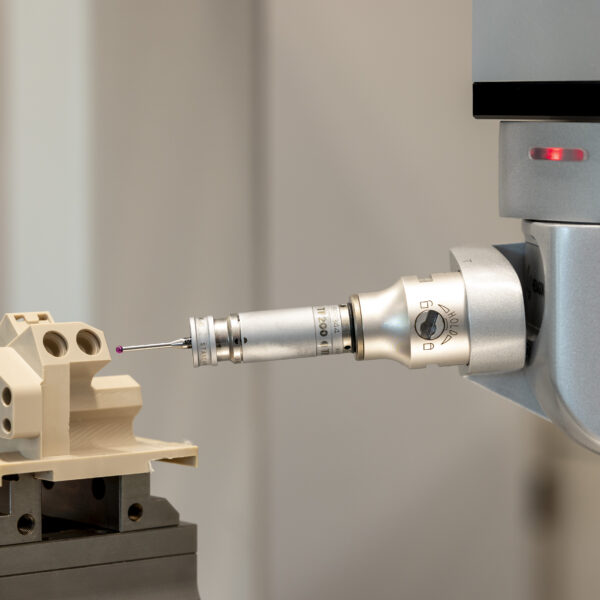
What is ISO 9001? Explanation of our strict policy on quality

ISO 9001: the standard in the field of quality management
ISO 9001 is well-known in the field of quality management. This internationally recognised standard can be seen as an important measure of transparency and reliability. A company which is ISO 9001 certified can demonstrate that it is constantly improving quality in order to increase customer satisfaction. A company or organisation can decide for itself how this will be carried out. ISO 9001 is therefore a generally applicable standard, independent of a specific sector or type of organisation.
The ISO 9001 standard therefore covers the entire work process: from advising customers and drawing up specifications to production, assembly, and (cleanroom) cleaning, right up to final delivery. In short, from customer demand to customer satisfaction. Checks are made to ensure that:
- The company can meet the wishes and requirements of customers and other stakeholders;
- All applicable laws and regulations are complied with;
- All processes and systems are aimed at continuously improving customer satisfaction.
BKB Precision: ISO certified for years
Since 1997, BKB Precision has had a certificate of quality which conforms to the ISO 9000 and later the ISO 9001 standard. Our customers and employees can see this in our high-quality plastic processing, the products we supply, and in the open working atmosphere that enables us to continuously improve ourselves.
We initiate improvement projects based on market developments or customer requirements. Improvements we make are recorded and regularly checked for effectiveness.
By communicating openly and effectively with employees, customers and other stakeholders, we keep in touch with what is going on in the market and with our customers. We also invest in training, state-of-the-art machines, and the latest production methods.
High-quality plastic processing thanks to a strict policy on quality
Without our strict policy on quality, we could never have developed into the reliable partner and specialist in high-quality plastic processing that we are today.
We understand better than anyone that the high-tech market segments we serve with custom-made plastics make strict demands on the durability and reliability of these complex, high-performance products.
As a link in the chain, we are well equipped to meet those demands. We do this, for example, by supplying various measurement reports and certificates. Whether plastics need to be machined, moulded, assembled or (cleanroom) cleaned, our well-trained, motivated staff are ready daily to meet every challenge and deliver products of great precision and high quality.



Need advice or more information?
Plastics milling: What are the trends in high-tech markets?
Trend 1: CNC milling
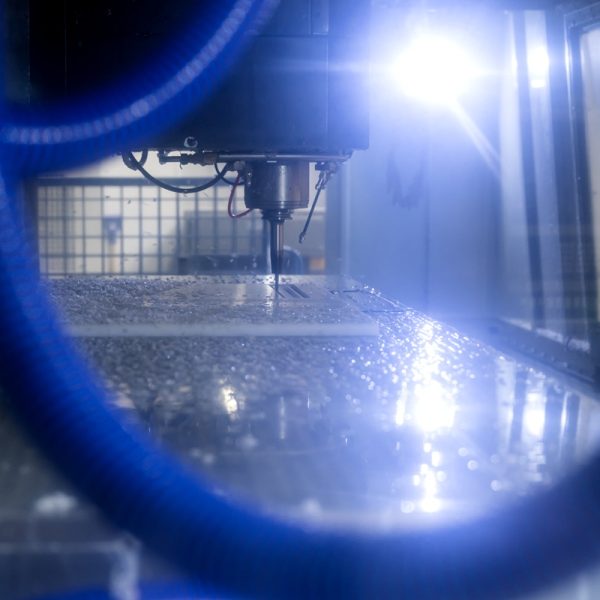
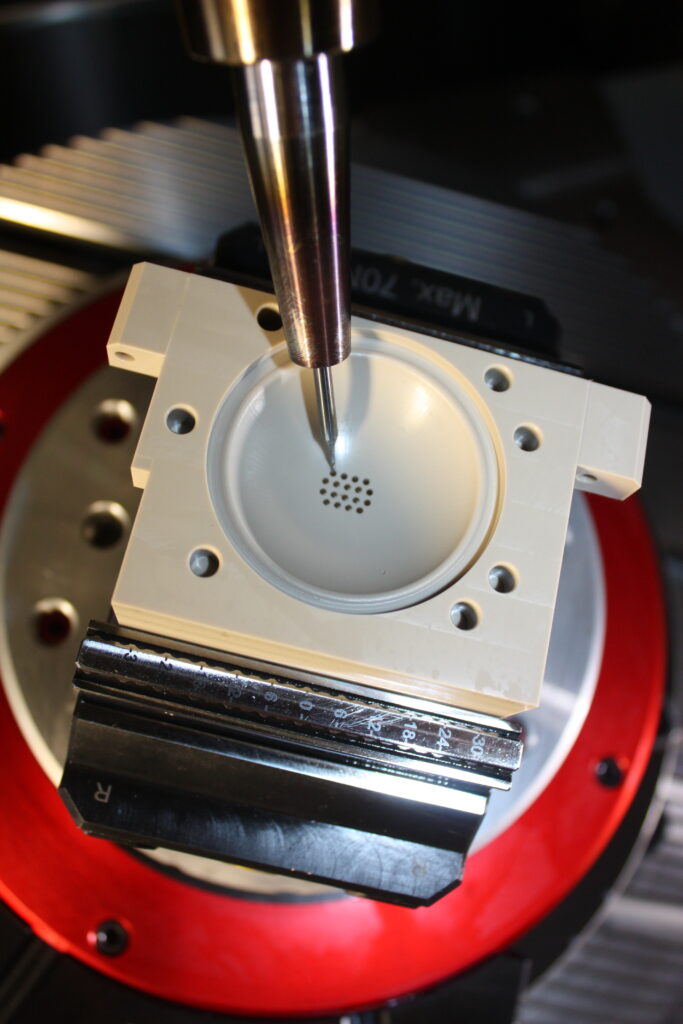
The way we mill plastics is rapidly changing thanks to technological developments. Where not so long ago it was skilled handwork, nowadays it is computer controlled. We call this CNC milling, where CNC stands for Computer Numerical Control. This means you can work faster and more accurately. For example, our advanced turning-milling machines can accurately process plastics of up to 3μm.
Moreover, computer-controlled milling makes it possible to carry out more complex procedures. This trend seamlessly meets the market’s need for innovative high-tech plastic products made to the highest possible quality requirements, and which are also manufactured with the greatest possible precision. In addition, CNC milling also means one can get a clear picture of complex designs at an early stage so that engineers still have the freedom to develop them further.
Trend 2: 5-axis simultaneous milling
Another technological feat we know everything about at BKB Precision is 5-axis simultaneous milling. This is the most advanced method of machining, in which all machining axes can be controlled simultaneously. It’s not for nothing that this technique is often used in the manufacture of highly complex products.
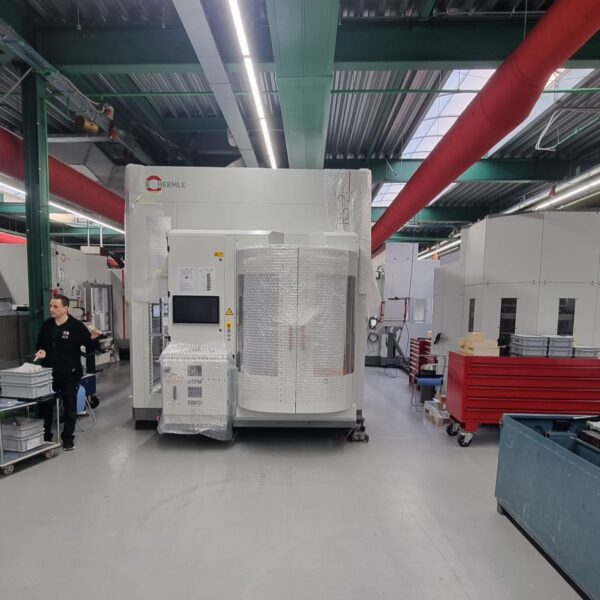
We have six such machines in our air-conditioned production hall, which includes robots. Thanks to robot loading, we can work even more efficiently and accurately. Trends and developments in this field are also advancing rapidly. The first robots to use self-learning algorithms are already on show at trade fairs. Of course, we keep close track of these developments.
Trend 3: Manufacturing plastic manifolds from high quality plastic
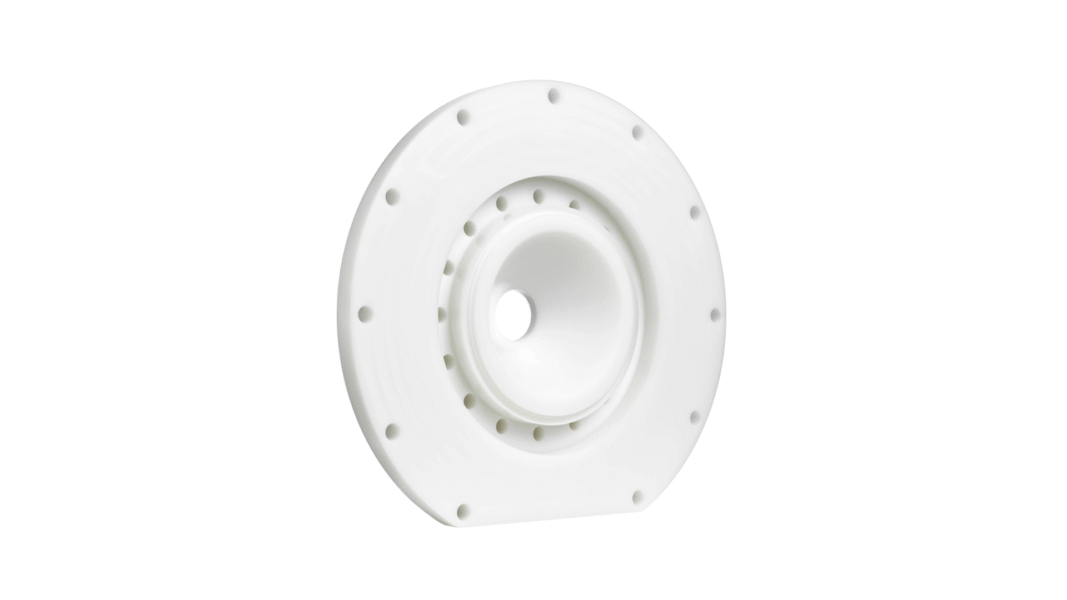
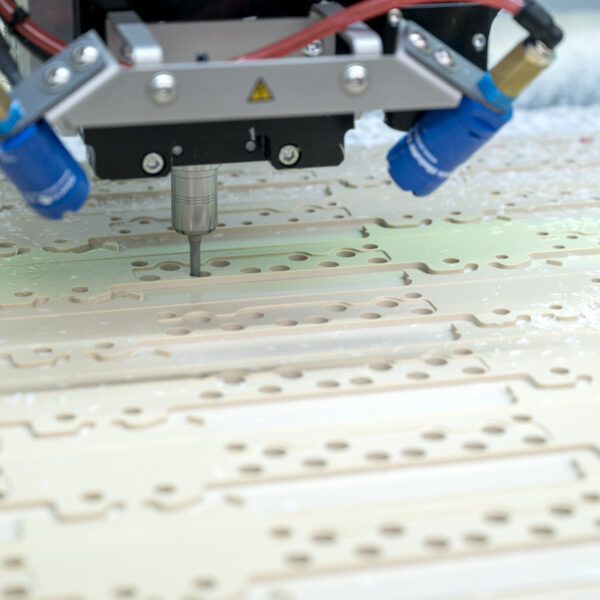
A plastic manifold has several branches or pipes. An important trend within the professional market is to have such a product manufactured from high-quality plastic. This is a highly future-proof solution at a relatively low cost.
In addition, plastic offers more design freedom and very high chemical resistance. High performance plastics such as PEEK or PEI in particular are excellent alternatives to metal components. Their low weight also means that highly dynamic systems perform even better.
Trend 4: High performance plastics milling
Another trend we cannot ignore is the growing demand for high performance plastics. These are plastics which perform well under extreme conditions, with qualities such as a high degree of temperature and chemical resistance. This makes such plastics ideal for the high-tech industry.
Consider applications in the aerospace industry, medical industry and semicon industry. Some high performance plastics can even be used as an alternative to steel. Thanks to our many years of experience in milling high performance plastics, we know all about its possibilities and can offer our customers the best advice in the field. You can also have your prototypes developed with us.
Need advice or more information?
What is thermoplastic? Examples and applications of thermoplastics
What are thermoplastics?
Thermoplastic is known for its flexible, pliable properties. This is due to the molecular structure of the material.
Thermoplastics consist of a long series of molecules, also called polymers. In their solid form, these chains of molecules lie against each other. However, when the polymers are heated, they become agitated and slide past each other, making the material pliable or even fluid.
A thermoplastic can therefore be easily bent or moulded into any desired shape. This makes the material highly suitable for injection moulding, although most thermoplastic materials are also available in sheet or semi-finished products.
Moreover, because thermoplastic can be reheated for short periods several times, it can be easily recycled and is therefore a type of sustainable plastic.
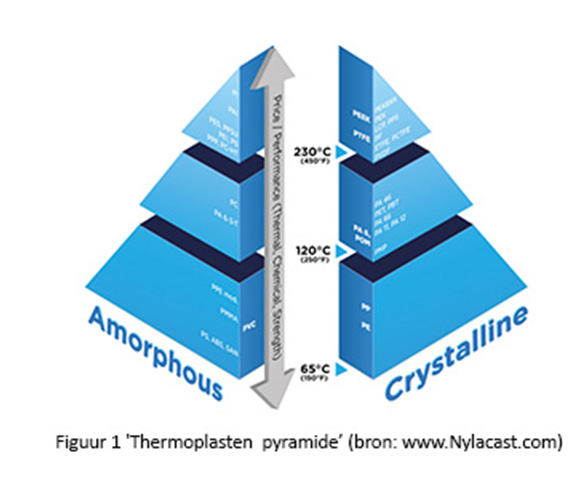
Thermoplastics can be subdivided into clear groups. This is also known as the ‘thermoplastic pyramid’ and is shown in figure 1. The triangle shows three layers, from bottom to top: standard plastics, technical plastics, and high-performance plastics.
Plastic PET bottles, packaging film and PVC tubes are well-known examples of thermoplastics. But many thermoplastics can also be used for industrial applications. POM is a frequently used material for mechanical applications. It is very good in the average range of properties, which makes it highly versatile.
However, nowadays PEEK plastic (polyether ether ketone) is increasingly used for many high-performance applications.
Thermoplastic application possibilities
PEEK plastics adhere to higher requirements than standard or technical plastics and can be machined very accurately, resulting in beautiful, high-quality parts with smooth surfaces. The technical properties of this type of thermoplastic include:
- Very strong and durable material
- Extremely good tensile and flexible strength with varying loads
- Low friction coefficient
- Good dimensional stability at high temperatures of up to 300°C
- Excellent chemical resistance
- Excellent hydraulic resistance
- Resistant to energy-rich radiation
- Self-extinguishing, according to UL94
- Low smoke and gas emissions
- Sterilisable
- Density of 1.32 g/cm³
As a result, this material is frequently used in the semiconductor, medical and pharmaceutical industries.
Types of thermoplastics
Thermoplastics can be subdivided into clear groups. This is also known as the ‘thermoplastic pyramid’ and is shown in figure 1. The triangle shows three layers: standard plastics, technical plastics, and high-performance plastics – these are at the top. As you can see, there are several differences within the groups of thermoplastics in terms of properties and application possibilities.
For example, some thermoplastics are highly suitable as material for the food industry because they meet specific requirements in the field of food safety. Other thermoplastics, such as PI (polyimide), have a high melting point and possess an intrinsic purity. This type of plastic is frequently used for high purity applications in the semicon and aerospace industries, and in primary research (CERN).
High-quality, high-performance thermoplastics can also be of great value in the chemical industry, including PPS and PTFE (Teflon). These thermoplastics are highly resistant to chemicals, acids and alkalis. PPS can also be found as components in braking systems, cooling systems, seals, and insulation applications.
Figure 1 ‘Thermoplastics pyramid’ (source: www.Nylacast.com)
Processing high-performance plastics such as thermoplastics
At BKB Precision, we have years of experience in the processing of high-performance plastics, including thermoplastics. When processing thermoplastics, we use state-of-the-art CNC machining and milling techniques, including 5-axis simultaneous milling.
Thanks to those years of experience, you can be confident that we will take care of the entire process from start to finish. We can provide you with extensive information and advice on what is and isn’t possible with the thermoplastic you require – all with one eye on the (product) specifications.