




CNC Milling vs. CNC Turning of Plastic: The Differences at a Glance
What is CNC milling of plastic?
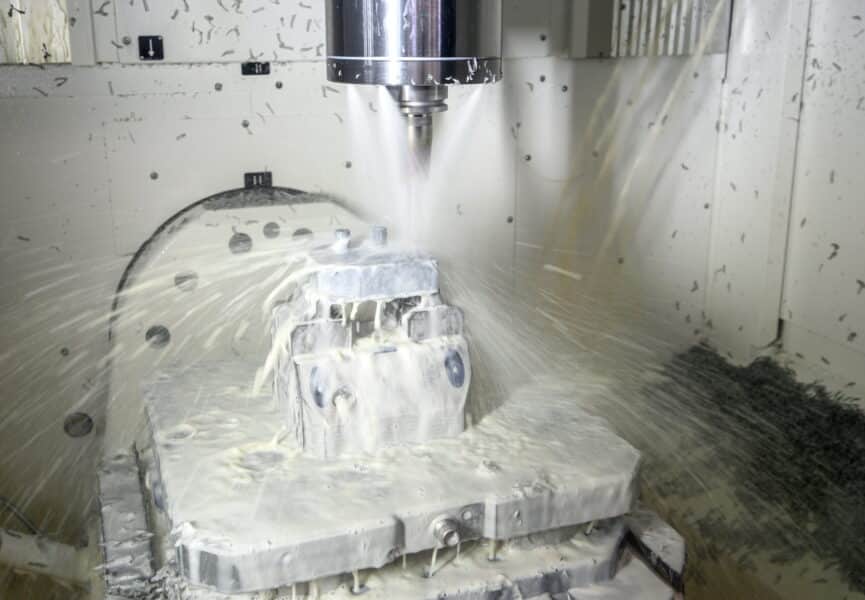
In CNC milling, the tool rotates while the workpiece is securely clamped in place or moves in a controlled manner along multiple axes. A rotating milling cutter removes material from a plastic block or sheet, creating flat surfaces, recesses, contours, and complex 3D geometries. Depending on the complexity of the part, milling is performed using 3, 4, or 5 axes simultaneously. With 5-axis milling, the part can be machined from multiple angles in a single setup, which improves both accuracy and efficiency.
For large plastic sheets, we at BKB Precision use gantry milling machines, which allow even large components to be machined with an accuracy of up to several thousand millimeters.

What is CNC turning of plastic?
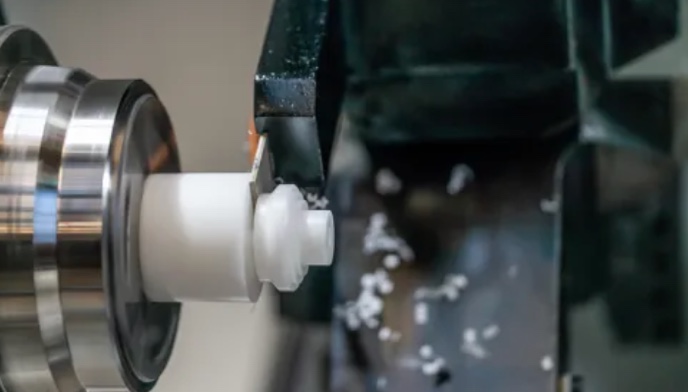
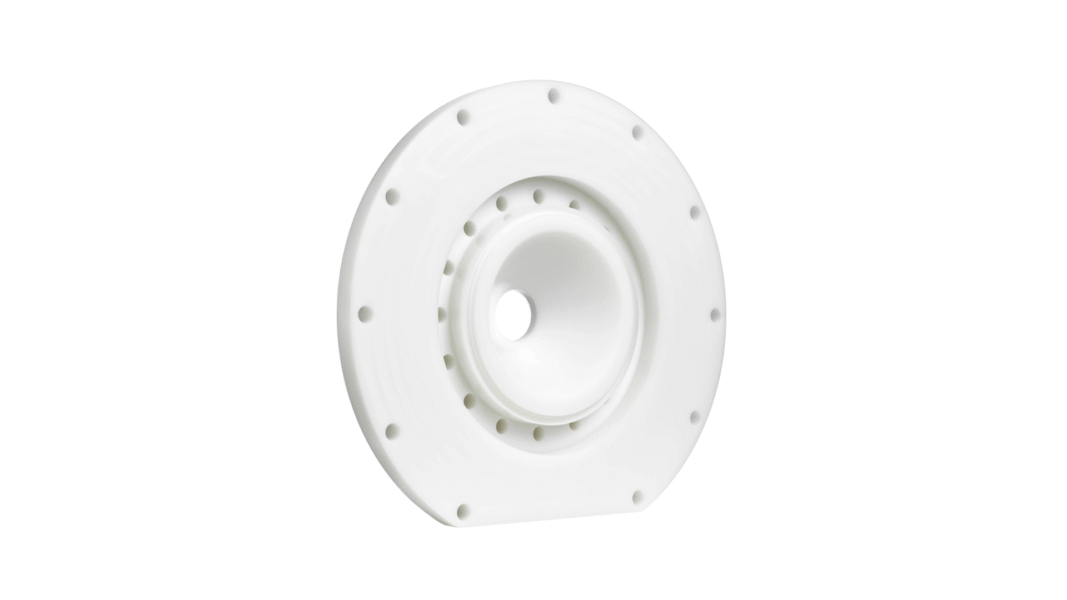
In CNC turning, it’s actually the other way around: the workpiece rotates at high speed around its axis, while a stationary cutting tool removes material. This technique is almost always applied to round bar stock and is ideally suited for cylindrical and conical parts such as shafts, bushings, flanges, and threaded parts.
One point to note that is specific to plastics: due to the clamping forces during turning, some materials may dent slightly. After unclamping, plastic partially recovers elastically, which affects the final roundness and fit. That is why at BKB Precision we work with controlled clamping forces and cutting conditions tailored to the material, ensuring that the desired dimensions are maintained.
The Differences Between Milling and Turning
The key consideration when choosing between milling and turning is almost always the same question: Is the part rotationally symmetric or not?
- Turning is the preferred technique for anything with a centerline: shafts, bushings, rings, conical shapes, and threads.
- Milling is the preferred technique for anything that isn’t round: flat surfaces, recesses, slots, multiple machining surfaces, and complex 3D contours.
Many parts combine both characteristics, such as a cylindrical part with a keyway slot. In that case, a combination of both techniques is necessary, something we’ll discuss in more detail in the decision guide below.
Milling and turning start with different forms of material, which directly affects material usage and waste:
- Turning almost always starts with round bar stock. This is efficient for cylindrical parts, but less suitable when non-circular features are required.
- Milling is more versatile in terms of material form: it uses block or sheet material. This is particularly important when working with sheets, as large plastic sheets are machined on gantry milling machines.
The effectiveness of both techniques varies depending on the production volume:
- For single pieces and prototypes, both techniques offer flexibility, although turning generally requires less setup work for simple round shapes.
- For small to medium-sized production runs (the area where we at BKB Precision excel—complex parts in low to medium volumes), the choice remains primarily geometry-driven: round and repeatable shapes lend themselves to turning, while complex and versatile shapes are better suited for milling.
- For larger runs of round parts, turning becomes relatively more efficient due to shorter cycle times per part. For larger runs of complex, non-round parts, milling remains the preferred method, possibly with setup aids to minimize setup time per clamping operation.
Both techniques are capable of highly precise manufacturing: at BKB Precision, we work with manufacturing tolerances as tight as ± 3 µm, thanks to a climate-controlled manufacturing environment, 5-axis machining centers, and automated processes.
When working with plastics, certain factors play a greater role than when working with metal:
- Heat buildup during machining can lead to minor dimensional changes more quickly in plastics than in metal.
- Clamping forces and elastic recovery primarily affect roundness during turning, as described above.
- Chip removal is important during milling: if chips become lodged, local heat builds up and dimensional accuracy deteriorates.
We address these factors by tailoring the cutting speed, feed rate, and machining strategy to the specific plastic.
The cost of a plastic part is determined by several factors, which vary depending on the machining technique:
- Setup and programming costs: Milling complex geometries typically requires more programming and setup work than turning a simple round part.
- Number of setups: Each additional setup takes time and increases the risk of dimensional deviations. 5-axis milling or a turn-mill combination can reduce the number of setups.
- Cycle time: For round parts, turning is generally faster per piece, which provides a direct cost advantage for larger production runs.
- Material waste: The choice between bar stock and block or sheet material determines how much scrap material remains.
For you, a well-considered choice of manufacturing technique upfront means: a shorter lead time, less rework, and a more predictable cost per part.
A Comparison of Milling and Turning
| Characteristics | CNC Milling | CNC Turning |
|---|---|---|
| Motion | The tool rotates; the workpiece is (largely) stationary | The workpiece rotates; the tool remains stationary |
| Suitable shapes | Flat, angular, and complex 3D geometries | Rotationally symmetric shapes (shafts, bushings, rings) |
| Material Form | Block or sheet material | Round bar stock |
| Batch Size | Single pieces to medium-sized batches; flexible in terms of complexity | Efficient for larger batches of round parts |
| Accuracy | Up to ± 3 µm; sensitive to chip removal and heat build-up | Up to ± 3 µm; sensitive to clamping force and elastic recovery |
| Typical cost considerations | More setup and programming work for complex shapes | Shorter cycle time per part for simple round shapes |
| Combination | Turning-milling combination possible for parts with both features in a single setup | Turning-milling combination possible for parts with both features in a single setup |
Decision Guide: Which Technology Is Right for Your Component?
- If your part is a shaft, bushing, flange, or has threads → choose CNC turning. This is the most efficient and precise way to produce rotationally symmetric shapes.
- If your part has flat sides, recesses, or a complex contour → choose CNC milling. With 3- to 5-axis milling, even the most complex geometries can be produced in just a few setups.
- If your part is round but also has a slot, hole, or flat side → a combination of processes is needed. For small quantities, this is typically done in two setups (turning first, then milling); for larger production runs or higher precision requirements, a turn-mill combination offers a solution, with both operations performed in a single setup. This reduces the number of setups and, consequently, the risk of dimensional deviations.
- Your part is a large plastic sheet requiring complex machining → CNC milling on a gantry milling machine is the recommended approach.
- You’re unsure about the right type of plastic for your application → the choice between milling and turning is closely tied to the material. Review the properties of engineering and high-performance plastics or contact us for material advice.
Still unsure which machining method is best suited for your part? Submit your drawing via a quote request, and we’ll provide you with no-obligation advice on the most efficient and precise approach.


Frequently Asked Questions
CNC milling is the best choice when a part is not rotationally symmetric: for flat surfaces, recesses, slots, or parts that need to be machined from multiple sides. CNC turning is more efficient for parts with a centerline, such as shafts and bushings.
Yes. Parts that are mostly round but also have a non-round feature, such as a slot or a flat side, are often turned first and then milled. For larger production runs or higher precision requirements, this can be done in a single setup on a turn-mill combination machine.
For simple, rotationally symmetric parts, turning is generally more cost-effective due to shorter setup and cycle times. For complex geometries, this comparison is not relevant, because turning is simply not the right technique in those cases. The final cost depends on the geometry, material, batch size, and the number of setups required.
Most of the engineering and high-performance plastics that BKB Precision processes, such as POM, PEEK, PMMA, PTFE, and PEI, can be both milled and turned. The choice of a specific material depends on mechanical stress, temperature resistance, chemical resistance, and the desired precision.
A turning-milling combination machine performs both turning and milling operations in a single setup. This is particularly relevant for parts that have both rotationally symmetric and non-circular features, as it reduces the number of setups. Fewer setups mean a lower risk of dimensional deviations and often a shorter turnaround time.
Yes. For large plates, BKB Precision uses gantry milling machines, which can machine even large components with an accuracy of a few hundredths of a millimeter.